
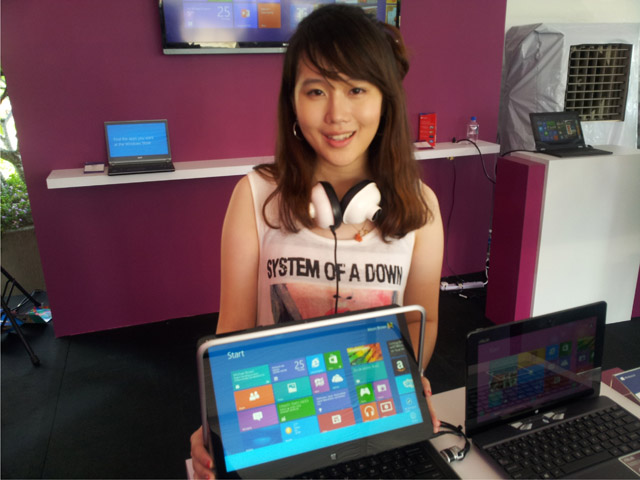
A model shows off one of several touch-screen laptops featuring the new Microsoft Windows 8 operating system, launched October 25 in the Asia-Pacific.TJ Dimacali
SINGAPORE - With the worldwide official launch of its Windows 8 operating system (OS) on October 26, Microsoft is banking heavily on touchscreen devices with an interface that is, by the company's own reckoning, "the most radically different since Windows 95."
Apart from numerous changes under the hood, the most glaring and most talked-about change in the new Windows OS is the lack of the once-ubiquitous Start button —a feature that has been on every version of the OS for the past 17 years.
The change has been a source of bewilderment and criticism from many consumers ever since Microsoft offered a "sneak peek" of the new OS via a Preview version available for free download since May this year.
The company, however, remains unfazed, touting a "new era of no-compromise computing experience" at the Windows 8 Asia-Pacific launch held in Singapore on October 25.
Microsoft showcased over a dozen devices—from desktop stations and wall-mount displays to tablets and "transformable" ultrabooks—running Windows 8's touch-optimized interface.
According to the company, its hardware partners have launched over 50 new devices in Asia alone specifically for the new OS. The list of partners includes Asus, Acer, Dell, Fujitsu, HP, Lenovo, LG, Samsung, Sony, and Toshiba.
In terms of hardware design, the manufacturers' range of products have been built around maximizing the touchscreen experience that Microsoft is touting with the new OS.
Many of these devices can best be described as "transformable" laptops. Some devices—such as the Dell XPS 12 and the Lenovo IdeaPad Yoga—have hinges that enable the touchscreens to be rotated or flipped beyond the limits of the traditional "clamshell" form factor. Other devices, such as the HP Envy x2 and the Acer Iconia W510, are essentially tablet PCs with detachable keyboards.
"I think that's the real reason why (people are) so excited about Windows 8: the different form factors, the different devices, and how they're going to use those," Tracey Fellows, president of Microsoft Asia Pacific, told GMA News Online in an interview.
She explained that Microsoft's strategy for this first generation of Windows 8 devices is to focus on touch input, although a variety of other input methods are still to be explored in the horizon.
"We see a transition from the familiar graphical user interface to a more natural user interface, so touch is part of that. Speech of part of that. We see ink-and-pen being a part of that. They were important design features for Windows," she said.
However, she also said that traditional interfaces, such as the keyboard and mouse, will continue to have a place in future products.
"There are certain tasks for which a (hard) keyboard is still very efficient, like there are certain tasks for which a mouse is still very efficient. But there are different ways and uses that will continue to evolve so that the computer does what you want it to do," Fellows told GMA News Online.
"Windows has been synonymous with flexibility, and we don't want that to change," she concluded.
According to independent statistics from NetMarketShare.com, Windows accounts for 83.37 percent of the global market for operating systems as of October this year, followed by Apple's Mac OS at just 6.3 percent. — DVM/KG, GMA News
0 comments:
Post a Comment